
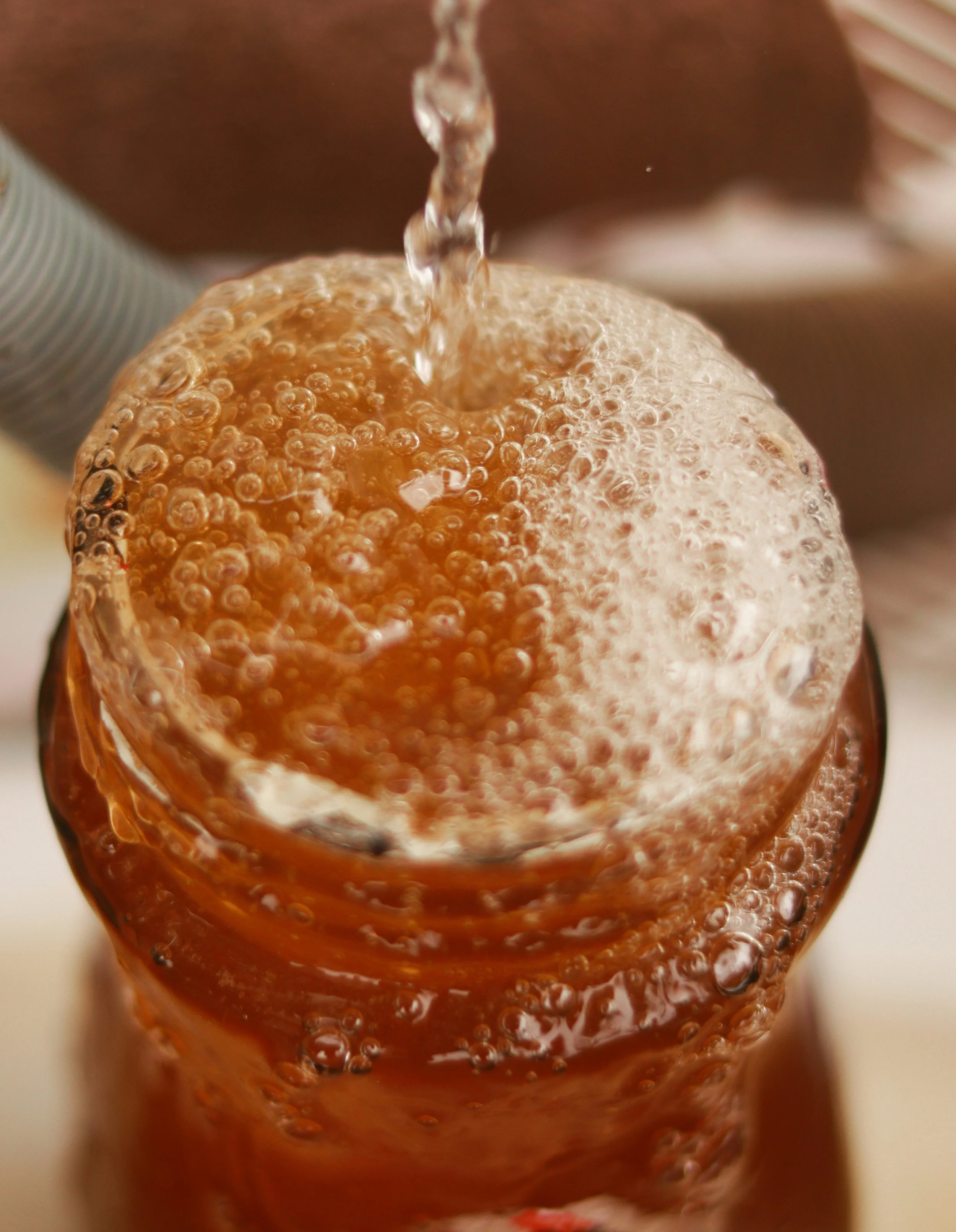
The fizzy bottle: how safe does it feel to lift the lid on ‘fizzy’ emotions and sticky subjects?
Have you ever experienced a build up of stress and difficult emotions that left you feeling like a shaken fizzy drink bottle, with only a tiny lid preventing the sticky contents from exploding all over the place? This is an image that’s been used in therapeutic settings and beyond for many years, but I’ve been thinking about it again recently, with so many things in the current climate causing our metaphorical bottles to be shaken up over and over again.
I’ve spent a long time supporting people to regulate their nervous systems, tackle overwhelming challenges and communicate with courage. While many of the themes that come up, tools that help, and trauma-informed principles in this work have stayed fairly consistent, the context has changed, and I notice that in the last few years, individual clients and teams I’ve worked with have needed an even gentler approach to lifting the lid on whatever is getting between them and their goals. It seems like there is a little more ‘fizz’ present for many people, and sometimes, an instinct to screw the lid on tighter, since the unknown of what might happen if it comes off is too much to risk. With more complex challenges at play, there may be a tendency to bottle up any emotions, unsayable words, or conflicts brewing under the surface, and attempt to keep calm and carry on. The risk in this approach is a build up of stress that can lead to explosive conflicts, burnout, health problems and more. I’m interested in how we can take the same approach we would use with a shaken up fizzy bottle – unscrewing the lid slowly, carefully, and a little at a time. This is part of a trauma-informed approach to addressing overwhelming challenges – slowing down and taking time to build safety and trust can reduce the risk of retraumatising and harming helping relationships.
Have you ever experienced a build up of stress and difficult emotions that left you feeling like a shaken fizzy drink bottle, with only a tiny lid preventing the sticky contents from exploding all over the place? This is an image that’s been used in therapeutic settings and beyond for many years, but I’ve been thinking about it again recently, with so many things in the current climate causing our metaphorical bottles to be shaken up over and over again.
I’ve spent a long time supporting people to regulate their nervous systems, tackle overwhelming challenges and communicate with courage. While many of the themes that come up, tools that help, and trauma-informed principles in this work have stayed fairly consistent, the context has changed, and I notice that in the last few years, individual clients and teams I’ve worked with have needed an even gentler approach to lifting the lid on whatever is getting between them and their goals. It seems like there is a little more ‘fizz’ present for many people, and sometimes, an instinct to screw the lid on tighter, since the unknown of what might happen if it comes off is too much to risk. With more complex challenges at play, there may be a tendency to bottle up any emotions, unsayable words, or conflicts brewing under the surface, and attempt to keep calm and carry on. The risk in this approach is a build up of stress that can lead to explosive conflicts, burnout, health problems and more. I’m interested in how we can take the same approach we would use with a shaken up fizzy bottle – unscrewing the lid slowly, carefully, and a little at a time. This is part of a trauma-informed approach to addressing overwhelming challenges – slowing down and taking time to build safety and trust can reduce the risk of retraumatising and harming helping relationships.
We might think about this in relation to therapeutic or supportive relationships, but it’s also relevant in workplaces and communities where there is ‘fizz’ building up while the priority is staying afloat during an economic crisis. When things are tough, it may seem inevitable that teams have to work harder, take less time for reflection, and deal with the stress of either making or being on the receiving end of difficult decisions. There may be strain on working relationships, brewing disquiet around working conditions, and anxiety about job security. There may be issues relating to inclusion, belonging or equity that people are unsure about raising during difficult times. Leaders may be working extra hard to try to protect their teams from as much of the impact of economic conditions as possible, and feeling resentful that their efforts are not recognised by the people they’re trying to support. These developing challenges may be close to the surface, with leaders conscious and anxious about lifting the lid; or it may be buried deeper, which in itself may be a sign of communication breakdown. I don’t want to be alarmist here – it’s entirely possible to make it through stormy waters without experiencing any of this, though it’s likely that there will be compromises, sacrifices, and risks involved in maintaining wellbeing, support and communication during hard times. The first step in preventing the organisational bottle from being shaken too hard is curiosity and willingness to examine it. Sometimes, this might be the most daunting step to take. Asking whether this is the right time, whether it’s worth the risk, and whether it’s necessary to ‘go looking for trouble’ feels reasonable, though we might find that we’re using our answers to these questions as a way to stay in the relative comfort of the familiar. The instinct to set aside complex issues that may take capacity away from the vital work involved in keeping services running is understandable. And on top of this, there’s the element of risk involved in taking the lid off, discovering just how fizzy things are inside, and having to clean up any resulting mess. If things aren’t at crisis point, is it really worth disturbing the peace? I’d argue that it’s often necessary, particularly when we know things are bubbling away under the surface, or if we’re not confident in our hopes and assumptions that everyone is ‘fine’ unless otherwise stated. Like the metaphorical fizzy bottle, there’s only so much pressure that can build up before something has to give, and that might show up in the form of conflict, relationship breakdown, illness, mass exodus, or other forms of crisis and challenge.
When we’re in survival mode, too busy to stop and catch up with ourselves and powered by adrenaline, we’re less able to consider and process nuance and complexity, to connect with others, and to consider problems from multiple perspectives. These are skills and approaches that are necessary and can be transformative when we’re responding to complex problems. When we’re fire fighting, we might feel as if we’re limited to choosing between taking the lid off in one go and facing the consequences, or continuing to move at pace and hoping that the building pressure dissipates by itself. Slowing down in order to tackle an increasingly challenging situation may sound paradoxical, but it’s likely to lead to better results. Pausing long enough to re-engage our most sophisticated brain functions, and letting out the fizz a little at a time is a strategy that aims to prevent overwhelm and exploding metaphorical bottles. So, how might that look in practice?
Setting boundaries and limits
It can feel overwhelming to create space for open, honest conversation and problem solving when there are a lot of complex issues to tackle, especially when some of them relate to external circumstances that we can’t change. Preventing things from spiraling into overwhelm requires boundaries. Agree what will be covered here, set a time limit and stick to it, and be clear on pathways for tackling issues that need to be deferred or revisited. It’s usually better to tackle challenging topics in smaller chunks, rather than seeking to get everything out in the open in one go. It can be helpful to schedule in ‘buffer zone’ time before and after a conversation that’s likely to bring some fizz to the surface, as well as beginning and ending with something that helps people to feel grounded and to remember that everyone in the space is a fellow human with an emotional world outside of their role in the space.
Choice and control
People generally need to know that they have power and choice in order to tackle emotionally charged territory successfully. There may be real limitations to the choices that they have in a given situation – in fact, that may be part of the reason for the increasing fizz in the first place. But explicitly stating the choices that are available can help to decompress and de-escalate. This might involve permission to take breaks where necessary, to participate in a way that feels possible for them, or to contribute to setting the agenda, the group contract, or the setting for a potentially intense conversation.
Deep listening
Where there might be a risk of conflict or distress, it’s important to listen to understand, rather than listening to respond. This is especially true for those with positions of authority in a team or group situation. It sounds simple, but takes practice and conscious effort to listen to someone who may be challenging, disagreeing, or expressing discomfort, without mentally preparing a response while they speak. Building a practice of approaching difficult conversations with curiosity can be powerful as a way to begin to relieve pressure in challenging situations.
External support
It can be helpful to explore fizzy territory with someone who isn’t directly involved in the situation. This might take the form of peer or leadership support with a colleague who has enough distance from the situation, exploring thoughts, feelings and ideas with a coach or mentor, or calling in some external facilitation to hold space for group conversations in a way that’s specifically designed to move at a manageable pace and provide a balance of maintaining boundaries and adapting to the needs in the room.
The bottom line for me is that the best, and often safest approach when pressure is building is to notice, acknowledge, and let the fizz out a little at a time. There may be discomfort, challenge, and things we didn’t want to discover along the way. But the fall out from the controlled demolition of a fragile status quo is likely to be less messy, and offer more learning opportunities than the explosion that might happen if we choose to keep shaking the bottle and hoping for the best.

Fear, Hope, Action!
New year is a time that, for many, symbolises hope. There’s the looking back and reflecting on the time that’s passed, followed by the ‘reset’ - positive intentions and desire for more of the things that went well and a chance to improve on the things that didn’t. This new year has been no different, in some ways. We all know that pandemics and political crises don’t care what date it is, and yet, we may wish to shed 2020 like a too-tight skin, casting its chaos into the past and looking towards brighter times. I’m always at my most reflective at the turn of a year – I enjoy the opportunity to pause, take stock and consider what’s next. And the extraordinary events of the last year have got me in full ‘meta’ mode – reflecting on reflecting. I’m interested in the nature and purpose of the hope that we may bring into a new cycle, and its relationship to fear.
New year is a time that, for many, symbolises hope. There’s the looking back and reflecting on the time that’s passed, followed by the ‘reset’ - positive intentions and desire for more of the things that went well and a chance to improve on the things that didn’t. This new year has been no different, in some ways. We all know that pandemics and political crises don’t care what date it is, and yet, we may wish to shed 2020 like a too-tight skin, casting its chaos into the past and looking towards brighter times. I’m always at my most reflective at the turn of a year – I enjoy the opportunity to pause, take stock and consider what’s next. And the extraordinary events of the last year have got me in full ‘meta’ mode – reflecting on reflecting. I’m interested in the nature and purpose of the hope that we may bring into a new cycle, and its relationship to fear. Recently, I’ve heard a few people say that they dare not allow themselves to hope, which strikes me as desperately sad. I’ve allowed myself to peek at a little crack of light coming from somewhere, but it seems dangerous to trust that the light source is the end of the tunnel. This seems at odds with my usual way of being these days – I worked for years on making cracks in my (frankly, very impressive) emotional suit of armour. There’s nothing like a persistent pandemic and its mismanagement to make me run towards the old familiar defences, I suppose! And I’m angry about some of my hope being ‘stolen’ because of a lack of competent leadership in the country I’ve moved to. I want to look ahead to thriving arts scenes, live music, hugs with friends and shared spaces, and use them as leverage to persist a little longer with the inconvenience and the fear. But it’s never long before my refrain of ‘I wonder how they’ll manage to screw it up this time’ kicks in. It reeks of powerlessness, and I don’t like to stay in that place for long.
And so, I notice a desire to take the anger about my dashed hopes for an end to feeling scared and being trapped in a seemingly endless cycle of locking down and opening up, and channel it into action. Action may not always have predictable consequences, but it exists in the here and now, the material world. Hope and fear, on the other hand, are essentially two halves of the same phenomenon involving looking ahead. We may also feel fear during a particular event, but the anticipation of what could happen seems to account for the majority of our fear and anxiety responses. The point is that we may often look to the future with hope, fear or a combination of both – they are responses to uncertainty, and there is plenty of that around right now.
In the last year, I’ve learned more about how I respond to risk, uncertainty and feeling powerless. I’ve taken risks that surprised me. I’ve endlessly weighed up the potential consequences of every small decision, so as to avoid causing harm to others. Sometimes I've put my foot down and advocated for my own and others’ rights, and at other times, I’ve been pulled reluctantly along a path that doesn’t feel quite right, forgetting all about my power. This range of responses will no doubt provide me with some useful information to ruminate over for a while, but what I’m left with again is the need to have both reflection and action. The next step, of course, is to figure out what that action is.
‘Hope over fear’ is a familiar soundbite for me as I cast my mind back to 2014 - it was a central concept in the Scottish Independence campaign. I’ll try to resist the temptation of rehearsing lengthy op-eds about the differences between Brexit and Indyref, or the difference in public trust in the Scottish and U.K governments’ handling of Covid-19 for now. Suffice to say that there was a powerful moment during that campaign when young people were more politically engaged than perhaps ever before, the signs in windows, street art, community events and polls spoke of hope, and of each of us having the power to contribute to real change. I think what I want is a bit of that feeling back. I know that this particular campaign has never gone away and I remain hopeful that we’ll be successful in the end. But I don’t just wish that feeling of solidarity and change for my own country – when we’re done with staying in our homes to protect each other, I hope that we’ll find other collective, proactive ways to protect each other and hold those in positions of power to account. Even as I write this, the defensive suit of armour is whispering in my ear ‘those who are taught they’re born to rule will do anything to cling to their power’, ‘what about all the people who have shown us they don’t care about others?’ and ‘how much can you really achieve when you’re up against a system meant to benefit the few?’ But I’ve concluded that, in order to get to action, I need to hold on to hope. Not blind optimism, but a healthy mix of hope and caution, perhaps. Maybe the healthiest approach really is to allow ourselves to believe that the light we can see is the end of the tunnel. And if it isn’t, the question becomes ‘what are we prepared to do about it?’

How we care for ourselves is political
The concept of self-care may bring to mind images of inspirational quotes typed in a flowing font, aimed at over-stretched, harassed working mums who desperately need and deserve to ‘take some me time’ and wash their troubles away in a fragrant bubble bath, chased by either a superfood smoothie or a ‘cheeky’ glass of wine. If I sound a little cynical here, I’ll admit that I am a little, and I’ll outline why. Rest assured, I am a lover of baths, smoothies, wine, relaxation and relief from the often-gendered work of caring for others. It is absolutely not my intention to shame those who practice specific ways of looking after themselves or the professionals who support them. I do want to unpack notions of self-care, emotional literacy and wellness, because I believe it’s in all of our interests to examine the industry built around them, the practices and products we’re sold and the voices that are centred or silenced. As Skunk Anansie proclaimed in the nineties (to the delight of my teenage self), “Yes, it’s f*cking political, everything’s political!”
The concept of self-care may bring to mind images of inspirational quotes typed in a flowing font, aimed at over-stretched, harassed working mums who desperately need and deserve to ‘take some me time’ and wash their troubles away in a fragrant bubble bath, chased by either a superfood smoothie or a ‘cheeky’ glass of wine. If I sound a little cynical here, I’ll admit that I am a little, and I’ll outline why. Rest assured, I am a lover of baths, smoothies, wine, relaxation and relief from the often-gendered work of caring for others. It is absolutely not my intention to shame those who practice specific ways of looking after themselves or the professionals who support them. I do want to unpack notions of self-care, emotional literacy and wellness, because I believe it’s in all of our interests to examine the industry built around them, the practices and products we’re sold and the voices that are centred or silenced. As Skunk Anansie proclaimed in the nineties (to the delight of my teenage self), “Yes, it’s f*cking political, everything’s political!”
“Who is self-care for?”
As mentioned, the most obvious and prolific presentation of self-care content often tends to invoke either soft, fluffy or expansive, spiritual imagery. Often, this is coded or read as “feminine”. I’ve spoken to numerous people who note that men, boys and masculine-identified folks can feel excluded from the message that looking after their bodies (exercise and protein shakes notwithstanding) and their emotional health is important. This can further exacerbate toxic masculinity stereotypes that are so harmful to boys and men, who so often come to harm as a result of pressure to keep their feelings to themselves. We are starting to see change, as a new generation of young people are taught that their emotions are valid, but the work of chipping away at the small stuff (which makes up the big stuff) continues. Here’s to more gender-neutral content AND permission for us all to like what we like, be it “fluffy” or otherwise.
What else comes to mind when we think of typical self-care? Next on my list is money. In a world where there’s money to be made from everything, good health may be sold to the highest bidder (and I say this as someone who charges for my wellbeing related services, though always with an eye on balancing the value of my work with my ethics). People who are financially struggling tend not to have much disposable income for wellness products and programmes, or time to themselves. So, what could self-care look like for those who don’t fit the financial mould? Well, the big picture is tackling poverty at its root cause. But back here ‘on the ground’, it can be about promotion and permission of solid boundaries to avoid burnout, quick and cheap wins (grounding techniques you can use on the bus, while boiling the kettle or walking the dog) and more subsidised places in therapy.
Who else do we picture when we think about self-care? Typically in the west, we may think of yoga classes run and attended by flexible white women, or mostly white, middle aged “spiritual seekers” attending packed conferences run by charismatic, inspirational leaders claiming to have all the answers. Clearly, these are sweeping generalisations, but the world of marketing is built on “ideal client” profiles that spell out the age, ethnicity, occupation and income of the people on the receiving end of advertising.
“We need to talk about cultural appropriation”
Deep breath – it’s a sticky subject, but all the more reason to lift the lid on it. The concept of taking aspects of a marginalised culture out of their original context and consuming or recreating them for fun, profit or wellbeing is not a new one. It’s not my story to tell as a white person, nor my right to define where the line between cultural appreciation and appropriation is (if indeed there is a neat line, which I suspect there isn’t). Let me be clear - I’m absolutely not saying it’s wrong to practice yoga if we’re not of Indian origin, or to learn meditation practices from ancient traditions other than our own. But I believe that it’s crucial to listen to the people with a claim to stake in specific practices, whose voices and incomes have so often been swept to the side in favour of a booming industry selling sacred symbols, medicines and practices to those of us who can see their value but know little of their history. Practising in awareness is and self-reflection is key (and for me, that goes hand in hand with self-care). So, I’m advocating for all of us who use or practice other cultures’ traditions to do our homework first (resource list below).
“Spiritual bypassing and toxic positivity”
If you’ve been going through a painful experience and sought solace in a community or content that suggests that all your troubles would be cured if only you had a positive attitude, the right diet or enough meditation, you may well know how dismissive and lonely an experience it can be. Humans often need to feel in control of our own destinies. Staring down the prospect of bad experiences and, ultimately, death, regardless of our best efforts can be a very scary experience. So, at times, we’d rather believe that if we smile more, take our supplements and attempt to avoid all known carcinogens, we’ll be just fine. I know that not all wellbeing and spiritual practitioners take this to its logical extreme (i.e. “all your suffering is your own fault”) - in general, we’re all just doing our best to survive and thrive. And there is a grain of truth in many of the encouragements to practice “mind over matter” or to foster a sense of perspective. But where reflection and the development of emotional regulation start to morph into “good vibes only” and “you just need to practice more gratitude”, we’re in the realm of toxic positivity and spiritual bypassing. Building a practice of noticing and honouring our physical and emotional cues in order to take better care of ourselves cannot and must not exclude uncomfortable emotions. Much like the aforementioned pressure on boys and men to suppress vulnerability, the discounting and banning of less socially acceptable feelings from any environment can be deadly. Our work here is to learn how to recognise, regulate and process. Sometimes emotional work is quite the opposite of sunshine and joy, and that’s ok. I will add an important caveat here, however – in a safe enough space for doing personal work, all emotions are welcome, but they are not forced out. We don’t get prizes for having the biggest breakthrough or the most dramatic catharsis. I’ve seen (and experienced) some truly transformative moments that have been loud, ugly and even a little scary… and I’ve seen people re-traumatised by well-meaning practitioners who lacked an awareness of how to spot signs that the Autonomic Nervous System is in overdrive and needs to be calmed, not pushed over the edge in order to get a gratifying “big finish” to a session. So, my suggestion here is to notice and work against internalising messages that imply that your feelings are unacceptable, and to check out the credentials of any practitioners you work with to ensure they have an understanding of trauma and psychological safety.
“Emotional literacy as a radical act, and how it can protect us”
Getting to know ourselves to the point of fine detail is a political and protective act in a number of ways. Let me give you an example… I remember learning what it means when the base of my skull sort of vibrates – for me, it’s an early warning sign that my nervous system has perceived a threat. It happens most in specific situations when I feel a conflict or a rejection may be imminent, but occasionally, I feel this sensation in a situation where the danger is more significant. This reaction takes place before my conscious mind has had a chance to catch up, so it’s a good barometer that says “hold on, let’s take stock – is this situation dangerous?” That knowledge has been really useful ever since. Another example – recently, I did some work with a group of young musicians who work in a genre I’ve never really connected with. When we first worked together, my initial response to the style of the music felt odd to me – a slight tensing of the muscles; perhaps out of defensiveness, or even disgust. I liked the young men and appreciated their art and their talent, so why was my body reacting like this? Thinking about it, I realised I’ve always considered this genre and the culture it comes from to be homophobic, and as a queer person, that makes me wary. While I stand by my condemnation of bigotry in any cultural context, I was surprised at myself. So many cultures and traditions have (I believe) been tainted by ultra conservative attitudes towards gender and sexual orientation, but I’m not sure I’d have been so quick to completely write them off, especially since these cultural contexts often necessitate and are home to incredible activists leading the struggle for change. It was my physical reaction and desire to interrogate its meaning that alerted me to the need to unpack and challenge my over-generalised assumptions. These signs and signals of something needing attention can also be crucial in protecting us from abuse and others’ narcissism. This is not to say that it’s incumbent on us as potential victims/survivors to stop it from happening, but I’m pretty sure we could all benefit from seeing the signs and connecting with our internal warnings.
“And speaking of narcissists…”
Listening to this slightly sensationalist account of a charismatic personal development “guru” whose extreme retreat courses saw several participants die on his watch, I thought about how two areas I have a special interest in are often rife with narcissistic process – namely, the performance and wellness industries. People in states of vulnerability who are seeking connection, escape, expression or fulfilment can offer rich pickings to a person intent on gaining power, wealth or notoriety at any expense. I think back to ‘artistically tempered’ artistic directors I encountered as a budding musician, and to coming across charismatic leaders of successful wellbeing companies and movements whose followers hung on their every word, even (or especially) when they were making impossible claims. While it’s true that a certain amount of passion, artistic flair and charm can be an asset to those who wish to share their craft and the tools that have worked for them, there is a line between this and more problematic narcissism that is often crossed in the pursuit of guru-like status. In Transactional Analysis terms, this state of mind says ‘I’m OK, you’re not OK’. I have the answers and you must listen to them without question. I lead and you follow. My pursuit of happiness is more important than yours, and you are a step on my ladder to the top. It is precisely the emotional literacy, curiosity and honouring of warning signs that can help to guard against being misled or mistreated by those who are in this position. And in an industry that people often seek out during their most vulnerable moments, we must demand ethics and regulation. It is the responsibility of those making claims to have life-changing products and resources to back them up with some kind of evidence and reference. If it sounds too good to be true, it may well be. I’m a big believer in seeking out practitioners who appear secure in their skills and knowledge base, yet are happy to acknowledge their humanity, their vulnerability and their capacity to get it wrong, learn and grow. I encourage us all to look for these qualities.
Now, go out there and take radical, political and compassionate care of yourself!
If you are worried about any of the issues mentioned in this post, please see the resource list below for (UK based) support & advice lines, or contact me.
Resource List:
The Guilty Feminist podcast episode 216, ‘Wellness’: https://guiltyfeminist.com/episode/?episode=271
‘Guru’ podcast (Wondery): https://wondery.com/shows/guru/
Unblocking White Supremacy and Fragility in the Wellness Industry - Maryam Ajayi: https://medium.com/@maryam.ajayi/https-medium-com-maryam-ajayi-unblocking-white-supremacy-and-fragility-in-the-wellness-industry-b7f312e33179
Cultural appropriation in the wellness industry – Lilidonia Lawrence: https://byp-network.com/news/267021
What is Spiritual Bypassing? Avoiding life and other dangerous games: https://www.insightstate.com/spirituality/spiritual-bypassing/
What is Toxic Positivity? Why It's OK not to be OK right now – Brittany Wong: https://www.huffingtonpost.co.uk/entry/what-is-toxic-positivity-coronavirus_l_5f04bca0c5b67a80bbff7cd3?guccounter=1&guce_referrer=aHR0cHM6Ly9jb25zZW50LnlhaG9vLmNvbS8&guce_referrer_sig=AQAAAIr5dlvYWdYLD45MxFwivtZKH5CAp9XePI0eecea-VCN8rXPqd6EWIKhAggZL04kxcPiz1hwlNRwMNtoujc1FBUT_8A_S-mMtny04gH9dWL5GnnwXcs8vMigJEyOKMJRzaCkLS9U-4Wq93CP7nCVEGLXlyO4O57n02Drpo8GjprF
Narcissism: How to Find Strength to Survive and Prosper After Narcissistic Abuse. Disarm the Narcissist, Take Control of Your Life and Learn How to Recover from a Toxic Relationship – Dr Keith Sam (Audiobook): https://www.audible.co.uk/pd/Narcissism-Audiobook/B086CBLJMK?msclkid=9431245897b119dc18ea7b17cd1e9eff&source_code=M2M30DFT1Bk12807021801O6
How to improve emotional intelligence: 10 tips for increasing self-awareness – Six Seconds: https://www.6seconds.org/2018/02/27/emotional-intelligence-tips-awareness/
Useful contacts from Mind, the mental health charity: https://www.mind.org.uk/information-support/guides-to-support-and-services/crisis-services/useful-contacts/
Transactional Analysis online course – I'm OK, you’re OK: how to develop your attitude: https://ta-course.com/im-ok-youre-ok/